
How long does garage floor epoxy actually last in Utah winters?
Manufacturer warranties say one thing. Mountain climates say another. Here’s the honest answer on epoxy lifespan in Utah and Wyoming garages — and what determines whether your floor makes it past year five.
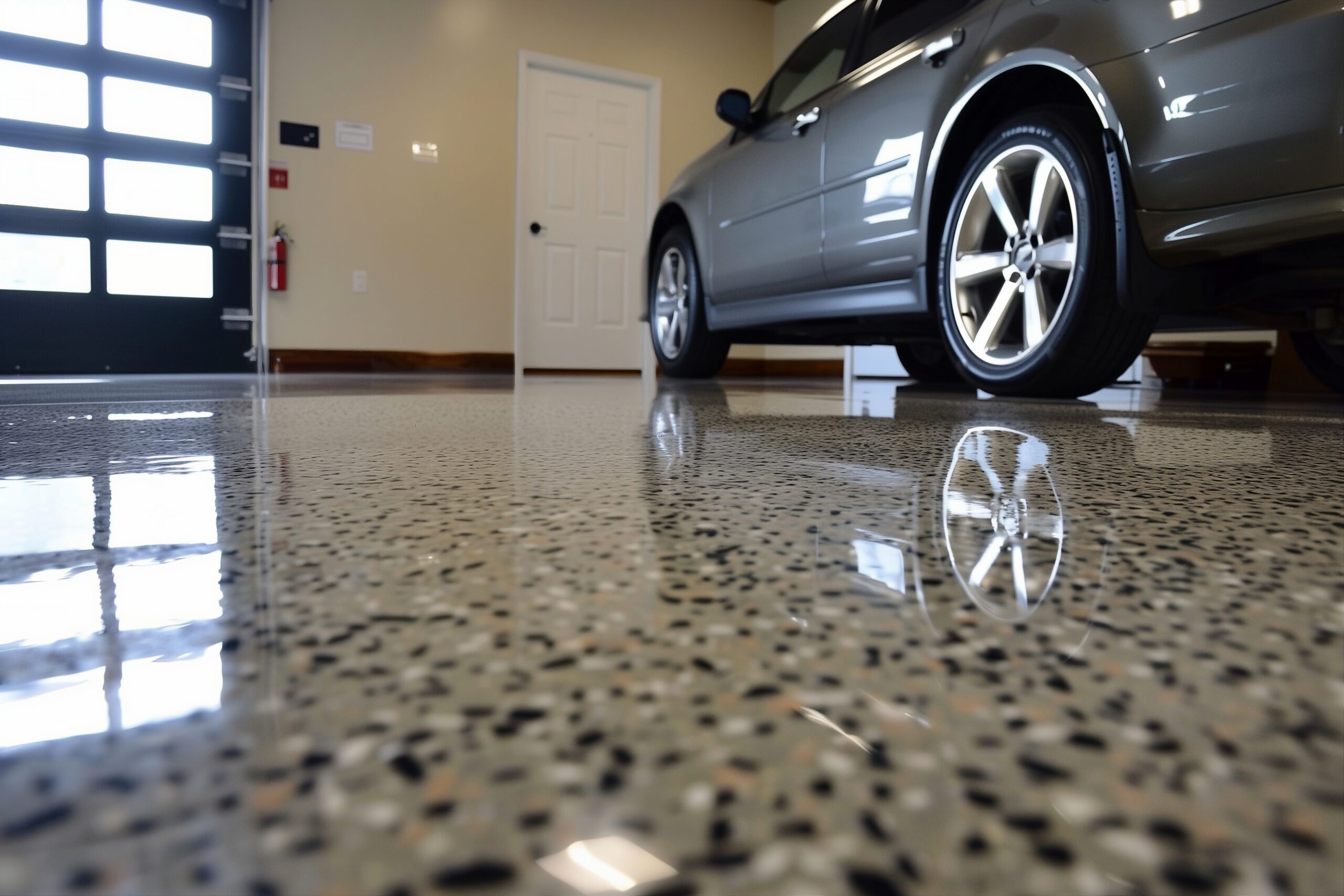
Walk into a 20-year-old garage in Heber Valley with a properly installed epoxy floor and it’ll look almost identical to the day it was poured. Walk into a 2-year-old garage in the same valley with a DIY kit floor and you’ll see flaking, hot tire pickup, and the kind of damage that makes the homeowner wish they’d never bothered.
Same climate. Same weather. 10x difference in lifespan. The question isn’t really how long does epoxy last — it’s what makes some floors last 20 years and others fail in 2?
Below is the honest answer for Utah and Wyoming garage floors, based on what actually drives longevity in mountain conditions.
The quick answer: 15–20+ years for professional, 1–3 years for DIY
Professionally installed multi-layer epoxy or polyaspartic systems in Utah and Wyoming should give you 15–20+ years of useful life with proper maintenance. Many last longer.
DIY rolled-on kit floors typically fail within 1–3 years from peeling, hot tire pickup, or moisture issues.
The difference isn’t the chemistry — it’s everything underneath the chemistry.
What actually kills epoxy floors in mountain climates
Three things destroy garage floor coatings in Utah and Wyoming. None of them are cold weather directly.
1. Bad concrete prep (the #1 cause)
Coatings fail because they lose their bond to the concrete underneath. That bond is established during prep — diamond grinding to open the concrete pores, removing all contamination, and creating the right surface profile. If prep is wrong, no chemistry on earth will keep the floor down.
Most failed floors trace back to one of these prep shortcuts:
- Acid etching instead of diamond grinding (cheap, fast, doesn’t open pores deep enough)
- Skipping moisture testing (water vapor pushes coatings off from below)
- Painting over cracks instead of chasing and filling them
- Coating over oil-saturated concrete without proper degreasing
- Applying coating below the temperature range the chemistry requires
Read more about why concrete prep matters and what proper prep actually looks like.
2. Wrong chemistry for the climate
Phoenix epoxy installed in a Star Valley garage will fail. Not because the product is bad, but because it was engineered for a different environment. Mountain garages need:
- UV-stable topcoats for sun exposure through garage doors
- Cold-cure chemistry for any winter installation
- Salt and chemical resistance for vehicles tracking in winter road treatment
- Hot-tire pickup resistance built into the topcoat formulation
- Freeze-thaw rated across the full thermal range
A premium polyaspartic system handles all five. A budget single-layer epoxy handles maybe one or two.
3. Thin material build
A 5-mil DIY kit and a 40-mil professional multi-layer system both call themselves “epoxy floors.” The DIY version has roughly 1/8th the material thickness. That’s not a minor difference — that’s an entirely different product class.
Professional installs build the system in layers: primer or moisture barrier, base coat, decorative element (flake, color), then two topcoat layers. Total dry-film thickness of 30–80 mil. DIY kits leave 5–10 mil after curing. They wear through.
Does cold weather actually matter?
Less than you’d think. Once a floor is properly cured, ambient temperature doesn’t affect coating longevity in any meaningful way. We have customers in Afton with 15-year-old coatings that look new despite a decade and a half of sub-zero winters.
Cold weather matters during installation — standard epoxy can’t cure below 50°F, which is why we use polyaspartic systems rated to 0°F for winter installs. But once cured, the floor doesn’t care if it’s January or July.
What does matter for mountain climates:
- Salt and chemicals tracked in from roads — coatings seal the slab from absorption
- Freeze-thaw cycles on the concrete underneath — the coating prevents moisture penetration
- Hot tires from highway driving in summer — polyaspartic topcoats handle this
- UV exposure through garage doors — UV-stable chemistry stays color-true
How to tell if your floor will last 15+ years
Before you sign a contract, ask the contractor these five questions. The answers tell you whether you’re getting a 15-year floor or a 3-year floor:
- What prep method do you use? The answer should be “diamond grinding” (or shot blasting on commercial). If it’s “acid etching,” walk away.
- Do you moisture-test the slab? The answer should be yes, with method specified (calcium chloride or RH probe).
- What system are you installing, and how thick? Should be a multi-layer build of 20+ mil total dry-film thickness.
- Is the warranty in writing and what does it cover? 10–15 years written, covering peeling, delamination, and hot-tire pickup. Verbal promises don’t count.
- Are you the installer or do you sub the work? Subcontractors mean inconsistent quality. Family-owned crews with direct labor mean consistency.
If the contractor can’t answer these clearly, your floor isn’t going to last.
What about maintenance?
Professional coatings are genuinely low-maintenance, but there are a few things that extend lifespan:
- Sweep regularly — grit grinds the topcoat over years
- Mop with pH-neutral cleaner or warm water — not vinegar, not bleach
- Blot up oil and chemical spills promptly — don’t let them sit for weeks
- Avoid harsh degreasers on the coating itself — they dull the finish over time
- Mind the floor jack stand pads — sharp metal point loads can dent some systems
That’s roughly it. No annual sealing, no special chemicals, no contractor return visits required.
The bottom line
A properly installed garage floor in Utah or Wyoming should last 15–20+ years with minimal maintenance. The factors that determine whether it makes it that long are prep quality, chemistry selection, and installer expertise — not the cold weather.
Cheap contractors save money by cutting on prep and chemistry. The savings disappear when the floor fails in 3 years and you pay to grind off the failed coating before redoing the job properly. The math never works out.
Spend the right amount upfront. Get the right system installed properly. Then forget about your garage floor for the next two decades.
Want a floor that actually lasts?
Free in-person estimates across Utah and Wyoming. We moisture-test, assess slab condition, and walk you through the right system for your specific space.
Request Estimate → Call 801·550·1186